

Flesh Wounds (excerpt)
"These people have never tried to dress themselves while fat..."

If you let them, people will cheerfully tell you that you can’t tell a book by its cover and that caring too much about clothes is superficial anyway, so there’s no reason to get too caught up in what you wear. The same people will also say, without any apparent awareness of the contradiction, that you should dress for the job you want and that clothes make the man, make comments on a person being overdressed or underdressed for a given occasion, and cheerfully register opinions no one asked for about what someone else should’ve worn instead of what they did. These people have never tried to dress themselves while fat.
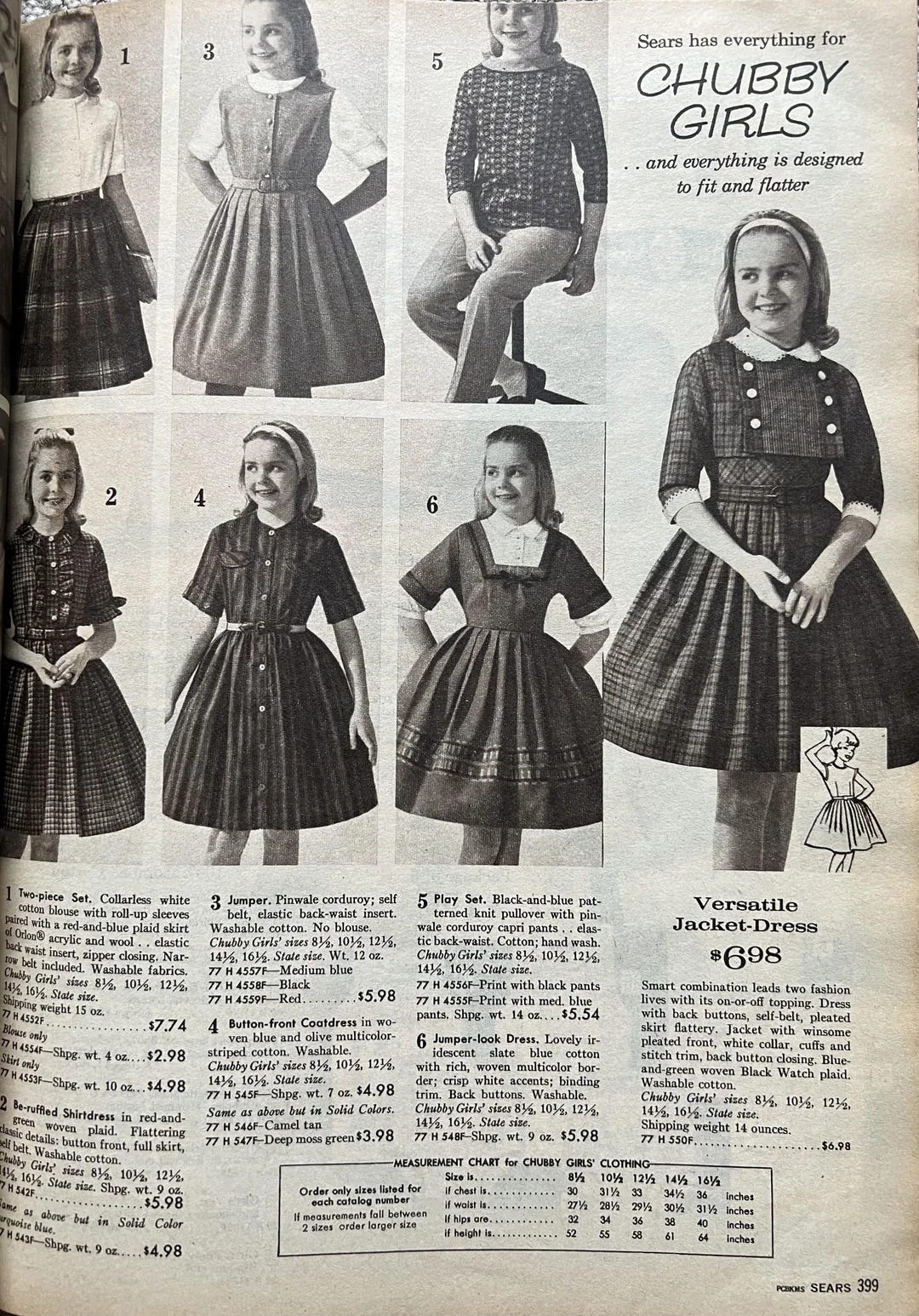
I learned my very first fat fashion lesson when I was a small child: having clothes that simultaneously fit you and that make you look the way you want to look is something that only thin people get to do. No one said this out loud. They didn’t have to. The lesson was self-evident in the racks at the Sears department store, one of the anchor stores of a now-dead mall in the suburbs on Cleveland’s east side, where my mother took my brother and I for clothes when we were young. The girls’ department spanned half a floor, it seemed, endless racks of options. Ruffled party dresses and denim jumpers, plaid polyester skirts and brightly-striped sweaters, blouses that buttoned all the way up to stylish spread collars and cute vests to wear over them were everywhere, as far as my little eyes could see. On the boys’ side there were fewer colors and of course no dresses or skirts, but still there were fringed suede jackets and bell-bottomed jeans and striped turtle-neck shirts and so many pairs of corduroy pants in every color in the dark-enough-to-be-masculine rainbow.
I stared wistfully across the floor toward the girls’ clothes while my mother picked things out for my brother and marched him off to the fitting room to try them on. I didn’t dare leave the spot where my mother told me to stand near the fitting-room door, no matter how much I wanted to go over to the girls’ clothes and look at them, fondle them, shove my arm deep into the rack to feel the soft pressure of garments pressing in on both sides, to hold them up in front of myself in a mirror to imagine what I’d look like in them. There wasn’t any point anyway. We weren’t headed that way, not even just for window-shopping purposes. Instead, once my mother had gotten what my brother needed, she would hand me the bags to carry as she took my little brother in hand and marched us all to the “Chubby” section in the back corner, approximately where the children’s clothes began to give way to the tools and hardware. Even now, the smell of 3-in-1 Oil transports me instantly and irrevocably to a particular brown-walled dressing room where my mother expressionlessly handed me polyester doubleknit pants to try on
.
The “Chubby” section, in its entirety, was about five racks. I seem to remember one each for skirts, dresses, and pants, with the other two for tops. Whatever fit me was more or less, what I ended up with although there were occasional exceptions when something that fit me was available in more than one color and I got to choose. There were no frilly party dresses in the “Chubby” section, and no plaid skirts. Navy blue was probably the most frequent color, as was a brownish-rust color, a dark green, and a few anemic pastels. White shirts were available, although my mother refused to buy them unless forced to by school picture day requirements, for it is a truth universally recognized that any child wearing a white shirt will invariably get food stains on it within hours of putting it on. Other things that my mother refused to buy included anything frilly, not that there were many such things in the “Chubby” department, and anything pink. These were, she told me, not flattering on “bigger” people.
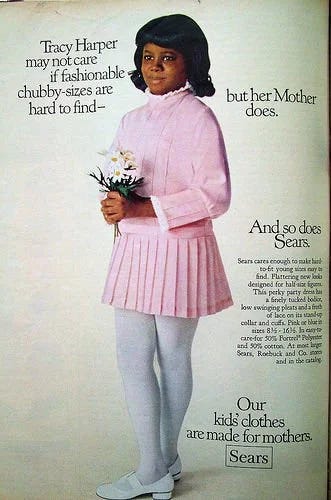
Thus I spent my elementary school years not only fatter and taller than most of the other kids, but also dressed in clothes that weren’t much like anyone else’s, drab and boxy in a way that made me weirdly androgynous. I hated it. They were so unpretty.
I could not say so. I had already learned not to admit that I wanted to be pretty. My mother, when I told her at the age of seven or so that I wanted to grow my hair long and wear more skirts, looked at me disappointedly and said “You don’t really want that, you just think you do. You’re not a girly girl.” She was right. I wasn’t a “girly girl,” because that, of course, meant being pretty and delicate and squeamish, liking baby dolls and dress-up and playing house, and neither being too smart or wanting to read everything I could get my hands on. I was solidly disqualified from being part of the queendom of girly-girls at school. It didn’t matter. I wanted to be a pretty girl anyway.
As far as my mother was concerned “pretty” was both frivolous and high-maintenance. She wore her hair short, and thus I did too. Long hair meant having to do things with it like braiding and brushing, plus it was vain. She wore practical clothes, and therefore so would I. Pretty dresses meant more intensive laundry. Besides, things like long hair and dresses were superficial. As an adult I realized this was perhaps the only thing my mother had taken away from her limited exposure to feminism, and it fitted in beautifully with her deeply internalized misogyny. I didn’t put two and two together at the time, of course. I just didn’t want to be superficial. It was obviously not a thing a person wanted to be.
So I told myself it didn’t really matter. It couldn’t possibly. Just because I wanted it didn’t mean it was something I needed. Just because I wanted it didn’t mean it would be a good thing for me to have. I taught myself how to hold these feminine desires lightly, so lightly I couldn’t really be disappointed when I didn’t get what I wanted. I could learn how to clap a hand over disappointment’s mouth, too, because there was no point in letting it speak. I would wear the clothes that fit me because that was what there was on the racks at Sears. There would be no attempt to find anything else, because what was there was perfectly good, and anything more or different would be superficial anyway.
The second fashion lesson I learned was that to be fat and a woman meant you had no choice about what kind of woman you would be in the eyes of the world. Somewhere around the sixth grade I had gotten too tall, as well as too fat, for there to be anything for me in the “chubby” racks. For a golden moment or two, perhaps as much as a year and a half, I could dress myself from the “misses” section, which of course meant clothes for actual grown-up women that came in sizes that went as far as a 12, maybe a 14. My mother was still the officiant of all shopping choices, but as the number of things on the racks that I could fit into expanded, so did the kinds of things I was allowed. There were no more dresses, nor things that looked too girly; these continued to be superficial. But there were some things I was allowed to choose for myself because I liked them, things in bright colors, things made of rayon or wool instead of acrylic or polyester, items where I liked the feel, the drape, the cut. I remember in particular an emerald-green sweater that I loved, merino wool and deeply discounted, that made me feel vibrant, interesting, maybe even pretty. Even more than I loved the sweater I loved the little tag at the back of the neck that proclaimed it to be a size medium. As long as that sweater fit me, I told myself, I wasn’t too big any more. I was a medium.
